Thursday, December 2, 2010

Wednesday, November 3, 2010
Alzheimer disease
In this studies of Alzheimer’s we learned many things, starting that this disease is fatal, once it begins it does not stop, it keeps on growing and does not go back, there is only the chance of Alzheimer slowing down in its growth with certain pills but there is no way it stops . We also saw that there is no exact thought on how this begins and what causes Alzheimer although there are speculations relating it to a part of the brain. We also learned that this disease usually hits you when you are 60 and every 5 years that pass you develop higher chances of getting Alzheimer, it is really improbable that you get it at 40 and 50 although it is possible. There are symptoms when you might get it but these are really hard to distinguish from natural aging, since they are really alike, like forgetting small things like where something is or having trouble articulating words. We also learned that there is no specific time limit in how long the stages in Alzheimer last since there are people who get less severe Alzheimer and people who get really severe one. The fatality on Alzheimer is that your body forgets how to do things such as breathing and the victim suffocates to death. We also learn that this is a really sad disease to watch somebody grow into since it just gets worse and worse, making the victim less independent, forgetting even their own family, but this disease has more effect on the family since they are the ones who watch the victim forget their identity, even people really close to them such as their children and wife. Studying this disease makes me conclude that I would prefer to die rather than bring such pain into my family and losing my identity.
Friday, October 29, 2010
Analysis 3 experiments
New Understanding Of How We Remember Traumatic Events
1. Conducted by: Neuroscientists at The University of Queensland
How it was conducted and results: They studied the amygdala under a cellular mechanism looking at the formation of emotional memories. They concluded that noradrenaline affects the amygdala by controlling chemical and electrical pathways in the brain responsible for memory formation.
Research applied to real-life: This research explains how you remember things for a very long time by the emotional impact it shows you. This results may also help other scientists discover better treatments for traumatic events.
 http://www.sciencedaily.com/releases/2008/10/081028103111.htm
Some Short-Term Memories Die Suddenly, No Fading 2. Conducted by: Weiwei Zhang, Steve Luck and Brain
How it was conducted and results: They developed a pair of tests that measured wether the memory still existed and the accuracy of the short term memory, these tests were giving to 12 adults.
In the first test, three squares of different colors flashed for a tenth of a second on a computer screen. After an interval of one, four or 10 seconds a wheel showing the entire spectrum of colors appeared on the screen. The three squares also reappeared, only now they were colorless and one of them was highlighted. They were asked to recall the color of the highlighted square and click on the area of the wheel that most closely matched it. Each subject repeated this test 150 times for each of the three memory retention intervals.
When subjects retained a memory of the color, they clicked very close to it on the wheel — the distance between the click and the actual color indicating the accuracy of the memory. When color had disappeared from memory, however, subjects clicked at random on the wheel.The second test was similar to the first, but used shapes instead of colors. Published in the April issue of the journal Psychological Science, the study found that subjects “either had the memory or didn’t have the memory,” Luck said, “and the probability of having it decreased between four and ten seconds. The memories did not gradually fade away.” The finding provides insight into the underlying mechanisms behind memory formation and retention.
Research applied to real-life: The findings are being incorporated into a study of people with schizophrenia.
http://www.sciencedaily.com/releases/2009/04/090429091806.htm

The Memories You Want To Forget Are The Hardest Ones To Lose
3. Conducted by: Keith Payne & Elizabeth Corrigan
How it was conducted and results: The UNC recorded the reaction of 218 participants to photographs, here they understood the ways that emotion constrains mental control and to the question of whether intentional forgetting can be helpful in coping with painful or traumatic experiences.
Research applied to real-life: This applies that your emotions place limits on the ability to control the contents of the mind, meaning that perhaps you feel mad, so then you are less likely to remember something or control yourself.

http://www.sciencedaily.com/releases/2007/08/070815105026.htm
1. Conducted by: Neuroscientists at The University of Queensland
How it was conducted and results: They studied the amygdala under a cellular mechanism looking at the formation of emotional memories. They concluded that noradrenaline affects the amygdala by controlling chemical and electrical pathways in the brain responsible for memory formation.
Research applied to real-life: This research explains how you remember things for a very long time by the emotional impact it shows you. This results may also help other scientists discover better treatments for traumatic events.
http://www.sciencedaily.com/releases/2008/10/081028103111.htmSome Short-Term Memories Die Suddenly, No Fading 2. Conducted by: Weiwei Zhang, Steve Luck and Brain
How it was conducted and results: They developed a pair of tests that measured wether the memory still existed and the accuracy of the short term memory, these tests were giving to 12 adults.
In the first test, three squares of different colors flashed for a tenth of a second on a computer screen. After an interval of one, four or 10 seconds a wheel showing the entire spectrum of colors appeared on the screen. The three squares also reappeared, only now they were colorless and one of them was highlighted. They were asked to recall the color of the highlighted square and click on the area of the wheel that most closely matched it. Each subject repeated this test 150 times for each of the three memory retention intervals.
When subjects retained a memory of the color, they clicked very close to it on the wheel — the distance between the click and the actual color indicating the accuracy of the memory. When color had disappeared from memory, however, subjects clicked at random on the wheel.The second test was similar to the first, but used shapes instead of colors. Published in the April issue of the journal Psychological Science, the study found that subjects “either had the memory or didn’t have the memory,” Luck said, “and the probability of having it decreased between four and ten seconds. The memories did not gradually fade away.” The finding provides insight into the underlying mechanisms behind memory formation and retention.
Research applied to real-life: The findings are being incorporated into a study of people with schizophrenia.
http://www.sciencedaily.com/releases/2009/04/090429091806.htm
The Memories You Want To Forget Are The Hardest Ones To Lose
3. Conducted by: Keith Payne & Elizabeth Corrigan
How it was conducted and results: The UNC recorded the reaction of 218 participants to photographs, here they understood the ways that emotion constrains mental control and to the question of whether intentional forgetting can be helpful in coping with painful or traumatic experiences.
Research applied to real-life: This applies that your emotions place limits on the ability to control the contents of the mind, meaning that perhaps you feel mad, so then you are less likely to remember something or control yourself.
http://www.sciencedaily.com/releases/2007/08/070815105026.htm
Thursday, October 21, 2010
the concept of memory.
1. Explain the concept of sensory memory.
Sensory memory is where you recieve information from your senses immediately and it goes into your brain. It is information retained by just a short period of time and then it is forgotten since it has no importance.
2. Give an example of sensory memory.
When you touch the table, when you stop touching it, you forget it.
3. What is the capacity of our sensory memory?
Being visual it lasts less than one second, and auditory it lasts less than four seconds.
4. Describe the concept of short-term memory.
Short term memory is the stage after sensory memory that happens after the selective attention which determines what pieces of information move on from sensory memory to short-term memory. Short term memory is often stored as images and sound, it provides a working space for short computations and then transfers it to other parts of the memory system or discards it.
5. What is the "magic number" as it relates to short-term memory and who conducted the experiment which established this measurement?
The conducter of the experiment was George Miller in 1956 and the magic number is +/- 2 applying it to 7, making it from the range of 5-9.
6. What is chunking?
Chunking is the configuring of large amounts of information into smaller amounts of information which are used as structured to accomodate memory and learning limitations.
7. What has been determined to be the ideal size of "chunks" for both letters and numbers?
Numers - 3-4
Letters - 3
8. Which mode of encoding does short-term memory mostly rely on, acoustic or visual?
acoustic
9. Explain the duration and capacity of long-term memory.
This type of memory can last from days to decades. Memories become long term with the proccess of rehearsal and meaningful association, this means that you see it quite often and you give it importance, therefore your brain remembers it for a longer period of time.
10. Explain in detail the Atkinson-Shiffrin Model of memory.
This model states that there are 3 ways of memory stores, sensory memory, short term memory and finally long term memory. It categorizes them by the duration they last, sensory being to the maximum of 4 seconds, short term memory being about 18-20 minutes, and it stores things by chunks, and finally long term memory which lasts up to a lifetime.
11. Identify three criticisms or limitations of the Atkinson-Shiffrin Model of memory.
1. Not all of the rehearsal leads to the improvement of retention
2. STM is in terms of the number of units that can be processed an any one time, he gave 7 +/- 2, but recent researchers have developed 5 +/- 2
3. The sensory stores are sensory systems, not memory systems as most people think of the term "memory."
12.Explain the Levels of Processing Model of memory.
This model concretes in Long Term Meory and the processing that occurs there, it gives an alternative to the multi store model that suggests info is transfered by rehearsal. This model suggests that the depth or level at which we process information determines its place in LTM and also how well we recall that information, meaning the more we think about it, the longer it stays in our head.
13. What is maintenance rehearsal - give an example.
Continiously repeating the material to be remembered.
Repeating vocabulary words to learn them.
14. What is elaborative rehearsal - give an example.
This time of rehearsal involves comparing something new with something you already know that is stored in your Long term memory.
Relating someone new you meet named John and associating it with someone you already know called John.
15. Who developed the Levels of Processing Model and the concepts of maintenance and elaborative rehearsal?
Craik and Lockhart developed in the year of 1972 the levels of processing models and the concepts of maintenance and elaborative rehearsal.
Sensory memory is where you recieve information from your senses immediately and it goes into your brain. It is information retained by just a short period of time and then it is forgotten since it has no importance.
2. Give an example of sensory memory.
When you touch the table, when you stop touching it, you forget it.
3. What is the capacity of our sensory memory?
Being visual it lasts less than one second, and auditory it lasts less than four seconds.
4. Describe the concept of short-term memory.
Short term memory is the stage after sensory memory that happens after the selective attention which determines what pieces of information move on from sensory memory to short-term memory. Short term memory is often stored as images and sound, it provides a working space for short computations and then transfers it to other parts of the memory system or discards it.
5. What is the "magic number" as it relates to short-term memory and who conducted the experiment which established this measurement?
The conducter of the experiment was George Miller in 1956 and the magic number is +/- 2 applying it to 7, making it from the range of 5-9.
6. What is chunking?
Chunking is the configuring of large amounts of information into smaller amounts of information which are used as structured to accomodate memory and learning limitations.
7. What has been determined to be the ideal size of "chunks" for both letters and numbers?
Numers - 3-4
Letters - 3
8. Which mode of encoding does short-term memory mostly rely on, acoustic or visual?
acoustic
9. Explain the duration and capacity of long-term memory.
This type of memory can last from days to decades. Memories become long term with the proccess of rehearsal and meaningful association, this means that you see it quite often and you give it importance, therefore your brain remembers it for a longer period of time.
10. Explain in detail the Atkinson-Shiffrin Model of memory.
This model states that there are 3 ways of memory stores, sensory memory, short term memory and finally long term memory. It categorizes them by the duration they last, sensory being to the maximum of 4 seconds, short term memory being about 18-20 minutes, and it stores things by chunks, and finally long term memory which lasts up to a lifetime.
11. Identify three criticisms or limitations of the Atkinson-Shiffrin Model of memory.
1. Not all of the rehearsal leads to the improvement of retention
2. STM is in terms of the number of units that can be processed an any one time, he gave 7 +/- 2, but recent researchers have developed 5 +/- 2
3. The sensory stores are sensory systems, not memory systems as most people think of the term "memory."
12.Explain the Levels of Processing Model of memory.
This model concretes in Long Term Meory and the processing that occurs there, it gives an alternative to the multi store model that suggests info is transfered by rehearsal. This model suggests that the depth or level at which we process information determines its place in LTM and also how well we recall that information, meaning the more we think about it, the longer it stays in our head.
13. What is maintenance rehearsal - give an example.
Continiously repeating the material to be remembered.
Repeating vocabulary words to learn them.
14. What is elaborative rehearsal - give an example.
This time of rehearsal involves comparing something new with something you already know that is stored in your Long term memory.
Relating someone new you meet named John and associating it with someone you already know called John.
15. Who developed the Levels of Processing Model and the concepts of maintenance and elaborative rehearsal?
Craik and Lockhart developed in the year of 1972 the levels of processing models and the concepts of maintenance and elaborative rehearsal.
Wednesday, October 13, 2010
Memory
So far in my class of IB Psychology we have been learning about memory and how it acts and things that may affect it and the possible results of these things affecting it. We have learned a lot about how it works, stages it undergoes, how it is different within the age we have, how it eventually declines and sometimes even crashes when things such as alzheimers where one loses memory, to the point the individual cannot recognize people it has lived with for his entire life. We also learned how there are things that affect what gets stored and what does not, such as emotion. Events can be highly emotional, perhaps scarring us for life, or making our brain repress that event. We also learned how memory affects learning and many experiments and theories such as Piaget's who made various experiments on memory, and finally making a foundation for how we learn and the different stages we undergo, and how our capacity of remembering things increases within our age, maximizing at the age of 25, and eventually declining after this year. Also we learn that not all of these things are trustworthy, since memory can be altered very easily, and that there are always exceptions to the learning stages that Piaget created.
Wednesday, September 8, 2010
Stroop
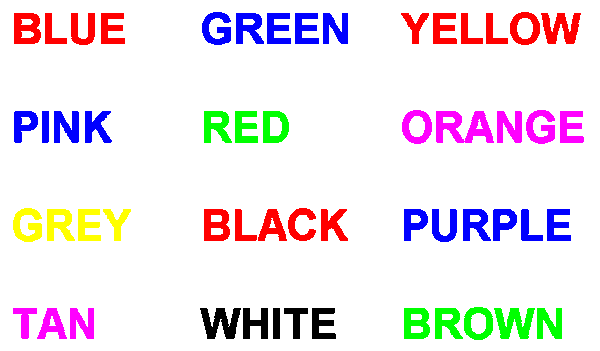
The stroop effect was an effect that was made popular by its discoverer John Ridely Stroop, which is used in psychological examples to introduce or explain certain things in the human brain due to the result of this test, being that the variation of colors with a word meaning a different color, slows your time more since you try to read the word not the color. The results of this is a slower time than the one of you saying the word with the correct color on it, showing the difficulty the brain encounters while doing this since it first tries to assort the problems it is encountering then you can finally think it and say the word since it has to process the word and the color, and which one does it want you to say. We did this experiment and class and there was an obvious difference in time between the time of the normal text with the normal color, and then changing the color with the different word, making it a perfect example of how it works. People who have not yet learned to read, have less problems doing this since their brain does not encounter the problem of processing the word and the color, making it faster for their brain, therefore the results will have an obvious difference between the one who can read and the person who cannot read. People get shocked when they do the test for the first time since they think an easy task like naming a colour will not take them much time, but they finish realizing the difficulty of this task.
http://www.wisegeek.com/what-is-the-stroop-effect.htm

http://www.wisegeek.com/what-is-the-stroop-effect.htm
Tuesday, September 7, 2010
Pygmies
The Bambuti Pygmies were a tribe of Africa that was isolated from all civilization and had no contact with other people until Colin Turnbull, an anthropologist that was studying civilizations in Africa, encountered this tribe and realized something real interesting, publishing some books on these observations and his discoveries. He had a Phd and had a kind of rough childhood, he saw many things and swore to defend and help out people who were needed and were minorities, in his attempts to study little tribes in Africa he discovers something really crucial about perception and the human mind, such as that humans learn about all the tricks in perception, such as things appearing smaller when they are further away from the human eye, etc. Things such as how a buffalo looks further apart compared to how it looks really close, the Bambuti Pygmies had not seen anything from long perspective since they were surrounded by trees and could not see things on a long perspective and when they saw things far away they got really scared, doing this Colin Turnbull learned that people learn that things further away are the same thing although they look smaller than what you are accustomed to see. This was a crutial and really important observation on the subject of perception and what it consist of, on how everybody see things on a different way. This further helps understand the human brain and what how we learn certain things, things that we think we have from birth, but in fact we have learned to see things in certain ways. 

Subscribe to:
Posts (Atom)