Wednesday, September 8, 2010

Stroop

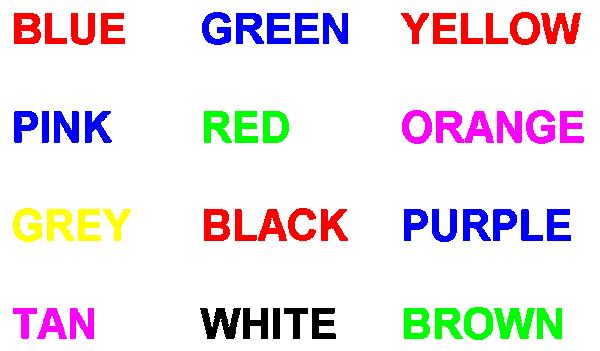
The stroop effect was an effect that was made popular by its discoverer John Ridely Stroop, which is used in psychological examples  to introduce or explain certain things in the human brain due to the result of this test, being that the variation of colors with a word meaning a different color, slows your time more since you try to read the word not the color. The results of this is a slower time than the one of you saying the word with the correct color on it, showing the difficulty the brain encounters while doing this since it first tries to assort the problems it is encountering then you can finally think it and say the word since it has to process the word and the color, and which one does it want you to say. We did this experiment and class and there was an obvious difference in time between the time of the normal text with the normal color, and then changing the color with the different word, making it a perfect example of how it works. People who have not yet learned to read, have less problems doing this since their brain does not encounter the problem of processing the word and the color, making it faster for their brain, therefore the results will have an obvious difference between the one who can read and the person who cannot read. People get shocked when they do the test for the first time since they think an easy task like naming a colour will not take them much time, but they finish realizing the difficulty of this task.

http://www.wisegeek.com/what-is-the-stroop-effect.htm


Tuesday, September 7, 2010

Pygmies

The Bambuti Pygmies were a tribe of Africa that was isolated from all civilization and had no contact with other people until Colin Turnbull, an anthropologist that was studying civilizations in Africa, encountered this tribe and realized something real interesting, publishing some books on these observations and his discoveries. He had a Phd and had a kind of rough childhood, he saw many things and swore to defend and help out people who were needed and were minorities, in his attempts to study little tribes in Africa he discovers something really crucial about perception and the human mind, such as that humans learn about all the tricks in perception, such as things appearing smaller when they are further away from the human eye, etc. Things such as how a buffalo looks further apart compared to how it looks really close,  the Bambuti Pygmies had not seen anything from long perspective since they were surrounded by trees and could not see things on a long perspective and when they saw things far away they got really scared, doing this Colin Turnbull learned that people learn that things further away are the same thing although they look smaller than what you are accustomed to see. This was a crutial and really important observation on the subject of perception and what it consist of, on how everybody see things on a different way. This further helps understand the human brain and what how we learn certain things, things that we think we have from birth, but in fact we have learned to see things in certain ways.

Tuesday, August 31, 2010

Change and Adaptation

He was a british anthropologist from the british upper class, he was openly gay and was famous in the 1960s-1970s for his critical and great observation on the Bambuti tribe in africa, in this he discovered something very crutial with perception. He graduated from the Magdalen College in Oxford, he later dies from AIDS and pneumonia. He studied in a prestigious school until he finished high school, a turning point in his early life was when he watched a friend get raped by other boys, and since then he swore to become successful and defend weak and unable people. Colin Turnbull participated in World War II serving in the British Navy. He is famous for two of his publications, The Forest People and The Mountain People. He was also famous for the music he recorded from the Mbuti pygmies, and when he published them they became widely known and really appreciated by the musicians.

http://www.newworldencyclopedia.org/entry/Colin_Turnbull
http://www.nytimes.com/1994/08/01/obituaries/colin-m-turnbull-69-anthropologist-and-author.html

Tuesday, August 24, 2010

Perception

Some internal factors that affect your perception are the habits because habits die hard and you react and percieve something according to the habitat you are in. Then comes motivational factors, which are factos that make your sensitivity of percieving something differnet. After comes learning, that is considered one of the big internal factors, since people percieve according to their learning level. Then come the external factors that influence your perception, such as the intensity in which something happens it makes the stimuli more percievable. Size is a big external factor, since the bigger or smaller something is, the easier or harder it is to percieve it. When two objects are in contrast, there is an easier view of the object or stimulus so you can more easily percieve it. There are more internal factors such as repetition, situation, etc that influence your perception, but they all have the common ground that the easier it is to see the object, the easier it is to percieve it.
Like:
The hour of 2:30 makes me happy because school ends.
Time to eat (8 am, 12 pm, 6pm) because it makes me feel like I am going to eat and feel satisfied.
When it is real late but I do not have to wake up early the next day, I feel really rested and nice.
When I see the red light of the blackberry go on it gives me a sort of anxiety
Saturday nights make me feel happy because the next day at morning I get a good breakfast.
Dislike:
When the clock goes 7:30 I feel depressed, its time for school to start
Sunday night, since it is the last time before school and its barely the beginning of the week.
When it is real late on school days I feel sad since I will be really tierd the next day.
The first class every day gives me a sense of boredom because it lasts more then usual, sometimes its two,
Entering the spanish class since we always talk too much it gives me a sense of boredom and sleepy feeling.


http://www.universalteacherpublications.com/mba/ebooks/ob/ch2/page3.htm
http://www.universalteacherpublications.com/mba/ebooks/ob/ch2/page4.htm



Wednesday, August 18, 2010

Perception is Reality

"Reality is merely an illusion, albeit a very persistent one." - Albert Einstein

This a philosophical statement that says "Perception is Reality" meaning that the perception of every person and its unique thinking shapes that person's reality and how they see everything. This means that every person has a different reality, and comparing it with Albert Einstein's quote, it says that there is no real reality, because reality means that there is one thing, it is the same for everybody, and with the different perception that every person has because they do not see the same thing and they do not love something or are dedicated to the same thing as much as someone else is. In example, you may love a book, you read it over and over again and never get tierd of reading it although you already know the ending and how everything is structed, and when it happens, there is another person who hates the book, the perception in this book is different, and in some bigger scales, perhaps not a book, changes the reality in which you live in, like jobs you like or dislike, or perhaps what subjects you like and are willing to spend time in for the rest of your life, maybe someone hates that and shapes your realities different. In conclusion, the different Perception of every human being shapes their reality in a different way, never being two alike.

Monday, August 16, 2010

Why do I study Psychology?

I study Psychology because I am enrolled in an IB program and there was the option to be either in French, Art or Psychology. I was originally enrolled in IB Art but then after recieving a brief explanation by the teacher to the people applying to it I figured it was too much homework for me to handle, so I dropped IB Art and figured I'd go to IB Psychology since I liked the class from last year.